
Family Conflict Consultation: A Practical Guide
Family conflict can feel like a never‑ending storm that drags everyone down. The good news is that a focused consultation can map the pattern, calm the tension, and set a new course for cooperation. Below you’ll find a step‑by‑step guide to what the process looks like, what it can fix, and when a Cincinnati‑based practice may be the right fit.
What Family Conflict Consultation Can Address
Consultation targets the repetitive cycles that keep families stuck. By looking at the whole system, not just one person, it uncovers hidden triggers, unmet needs, and the ways each member’s behavior reinforces the next. For example, a parent’s quick‑draw criticism may spark a teen’s silent withdrawal, which in turn fuels the parent’s frustration. The loop repeats until a neutral third‑party shines a light on it.
In family consultation , making these cycles visible can help families rebuild attachment, empathy, and stability. The therapist sets clear goals, tracks key interaction moments, and offers concrete tools for change. Common issues that respond well include chronic arguing, power struggles over chores, blended‑family role confusion, and escalation that leads to emotional shutdown.
Beyond the immediate calm, consultation often improves long‑term resilience. Families report fewer relapses into old patterns and greater confidence in handling future stressors. Take the free two‑minute family peace assessment to see if this approach matches your needs.
Map the Conflict Cycle Without Assigning Blame
At the heart of any consultation is a visual map of the conflict cycle. The therapist watches a typical disagreement, notes who reacts first, how each response escalates, and where the pattern resets. This map replaces blame with shared responsibility, because every step is shown as a reaction to the previous move.
Family systems theory tells us that conflict serves a regulatory function, it can protect a member’s sense of safety or maintain a hidden hierarchy. When the map is laid out, families see that their “problem” is really a set of predictable steps, not a moral failing.
One usable tool is a visual representation of the pattern. It shows how heightened arousal narrows thinking, which then fuels more intense reactions, and finally locks the pair into a defensive stance. By learning to pause before the loop closes, families can insert a calming pause and choose a different path.
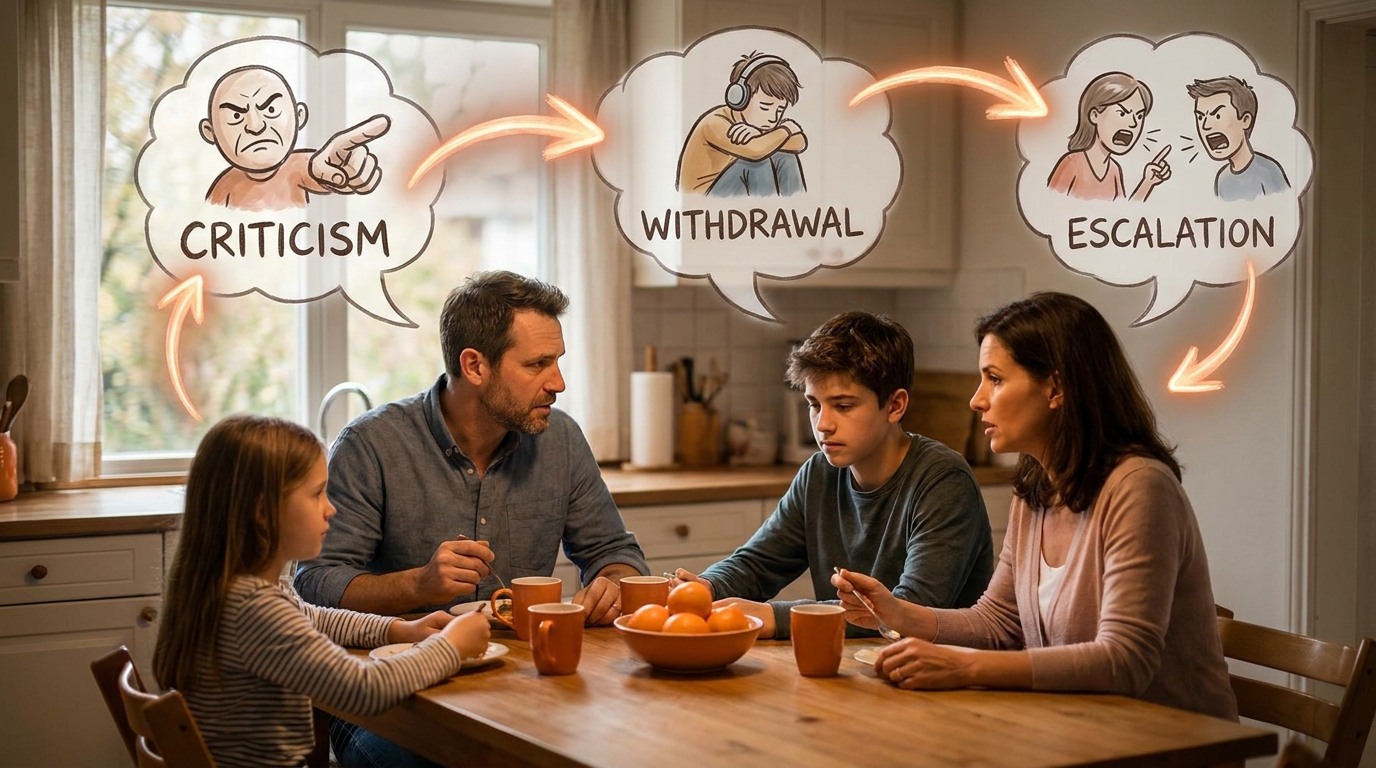
Seeing the cycle on paper often produces an “aha” moment. Parents notice that their rapid correction triggers a child’s shut‑down, and the child’s silence then fuels the parent’s sense of helplessness. The therapist helps the family re‑write the script: a brief pause, a calm statement of feeling, and a joint problem‑solving step.
Turn Consultation Into Cooperation at Home
Mapping is only the start. The real work begins when families practice new interaction habits in everyday life. Therapists coach parents to model emotional regulation, teach children to label feelings, and guide the whole unit toward collaborative decision‑making.
Techniques from family-systems and attachment-informed approaches can help families reshape boundaries. For instance, a parent might set a clear limit on screen time while also offering a calm explanation of why the limit matters. The child learns that limits are not punishments but safety nets.
Emotionally Focused Therapy adds a layer of secure‑base building. When a parent consistently validates a teen’s frustration, the teen may feel seen and remain engaged rather than retreat.
Fostering Growth and Cooperation offers workshops that turn the one‑on‑one work of consultation into group practice. Participants rehearse “win‑win” negotiations, practice reflective listening, and receive feedback in a supportive setting. The skills transfer to dinner conversations, bedtime routines, and even holiday planning.
Explore the Programs , Fostering Growth & Cooperation
After a few weeks of practice, families often report a shift from “who’s wrong?” to “what can we try next?” That shift is the hallmark of cooperation.
Know When Cincinnati‑Based Support May Help
Not every disagreement needs a therapist, but certain signs suggest it’s time to call in professional help. Repeated arguments that never resolve, emotional spikes that linger for days, or a sense that the family is walking on eggshells are red flags.
Chronic conflict can raise anxiety, trigger depressive symptoms, and disrupt sleep. When those symptoms appear, a consultation can break the cycle before it entrenches deeper mental‑health issues.
For Cincinnati families, Fostering Growth and Cooperation provides a hybrid model: in‑person sessions for hands‑on work, telehealth for busy schedules, and group workshops for shared learning. Their therapists are trained in CBT, DBT, EFT, and family systems, giving them a toolbox that matches the varied patterns families bring.

If you notice any of the following, consider reaching out: arguments that repeat without resolution, emotional shutdowns, feeling unheard, impact on work or school, or a major life transition that spikes tension. A brief intake can determine whether a full consultation, a short‑term workshop, or individual coaching is the best next step.
Read the Usable Framework for Reducing Family Conflict
FAQ About Family Conflict Consultation
What is family conflict consultation?
Family conflict consultation is a short‑term, focused process where a therapist maps the interaction patterns that fuel recurring disputes and teaches the family new ways to respond.
How long does a consultation typically last?
Most consultations run from three to six weekly sessions, each lasting about 60 minutes, but the exact length depends on the family’s needs and goals.
Do I need to involve every family member?
Ideally, the key participants in the conflict join the sessions, but the therapist can work with a subset and still address the larger system.
Will insurance cover family conflict consultation?
Fostering Growth and Cooperation accepts many major insurers, and they can provide a superbill for out‑of‑network reimbursement if needed.
How is this different from regular family therapy?
Consultation zeroes in on the specific conflict cycle and delivers concrete tools quickly, whereas traditional family therapy may explore broader relational history over a longer period.
Conclusion
If repetitive arguments are wearing you down, start with a family conflict consultation at Fostering Growth and Cooperation. Take the free two‑minute family peace assessment today at www.fosteringgrowthandcooperation.com/start-assessment, then schedule a first session to understand recurring patterns and begin building cooperation.
References
Johnson, S. M. (2008).Hold Me Tight: Seven Conversations for a Lifetime of Love. Little, Brown Spark.
Gottman, J. (2024). Emotion regulation and the conflict cycle.The Gottman Institute Blog. Retrieved from https://www.gottman.com/blog/emotion-regulation-transform-your-conflict-cycle/
Stavros, A. (2022). Family systems and conflict resolution. InFamily Therapy Handbook(pp. 45‑68). IntechOpen. Retrieved from https://www.intechopen.com/chapters/65598


Comments