
Parenting Skills Counseling: 5 Options for Families

Finding the right help for parenting challenges can feel overwhelming. Below are five solid options you can consider, each with a clear focus and a glimpse of who it might fit best.
When you’re ready to see how a choice lines up with your family’s needs, try our quick family peace assessment to get personalized guidance.
1. Individual Parent Counseling: Build everyday skills and confidence
Individual parent counseling is a one‑on‑one session that zeroes in on the parent’s own habits, stress triggers, and communication style. It’s great for parents who feel stuck or want to boost confidence in discipline decisions.
Therapists often use behavioral‑psychology tools to map out patterns and then practice new responses in the safe space of a session.
Fostering Growth and Cooperation offers this service in Cincinnati, blending evidence‑based methods like DBT skills for emotional regulation (Linehan, 2015) with real‑time role‑plays. Sessions can be in‑person or via secure video, so you can keep the work going even with a busy schedule.
2. Family Systems Counseling: Shift recurring family interaction patterns
Family systems counseling looks at the whole family unit as a network of relationships. It helps spot repeating cycles, like a child’s defiance sparking a parent’s criticism, that keep the household stuck.
Therapists draw on structural family therapy (Minuchin, 1974) to rearrange roles, set clearer boundaries, and create healthier feedback loops. When families learn to see each other as parts of a system rather than isolated problem sources, tension often eases.
At Fostering Growth and Cooperation, the team maps out these patterns and then guides families through small experiments, such as a weekly “check‑in” meeting that keeps everyone on the same page.
3. Attachment‑Focused Counseling: Strengthen connection through repair
Attachment‑focused work helps parents and children rebuild trust after conflict. It emphasizes repair conversations that acknowledge hurt, take responsibility, and set a hopeful tone for future interactions (Johnson, 2019).
Fostering Growth and Cooperation runs a skills‑based parenting group where parents practice repair scripts, learn to read their child’s cues, and receive feedback from the therapist and peers. The group format adds peer support, which many parents find reassuring.
4. Parent‑Child Counseling: Practice communication together
Parent‑child counseling brings both parties into the same session. It’s useful when miscommunication has built a barrier that feels hard to cross alone.
The therapist guides the pair through structured activities, like “active listening circles” or “emotion‑labeling games”, that offer practice in respectful dialogue.
Working together in the room helps parents see how their own reactions influence the child’s behavior in real time.
5. Co‑Parenting Counseling: Coordinate caregiving across households
Co‑parenting counseling supports parents who share custody or live apart but need to present a united front. It focuses on communication protocols, shared calendars, and consistent rules across homes.
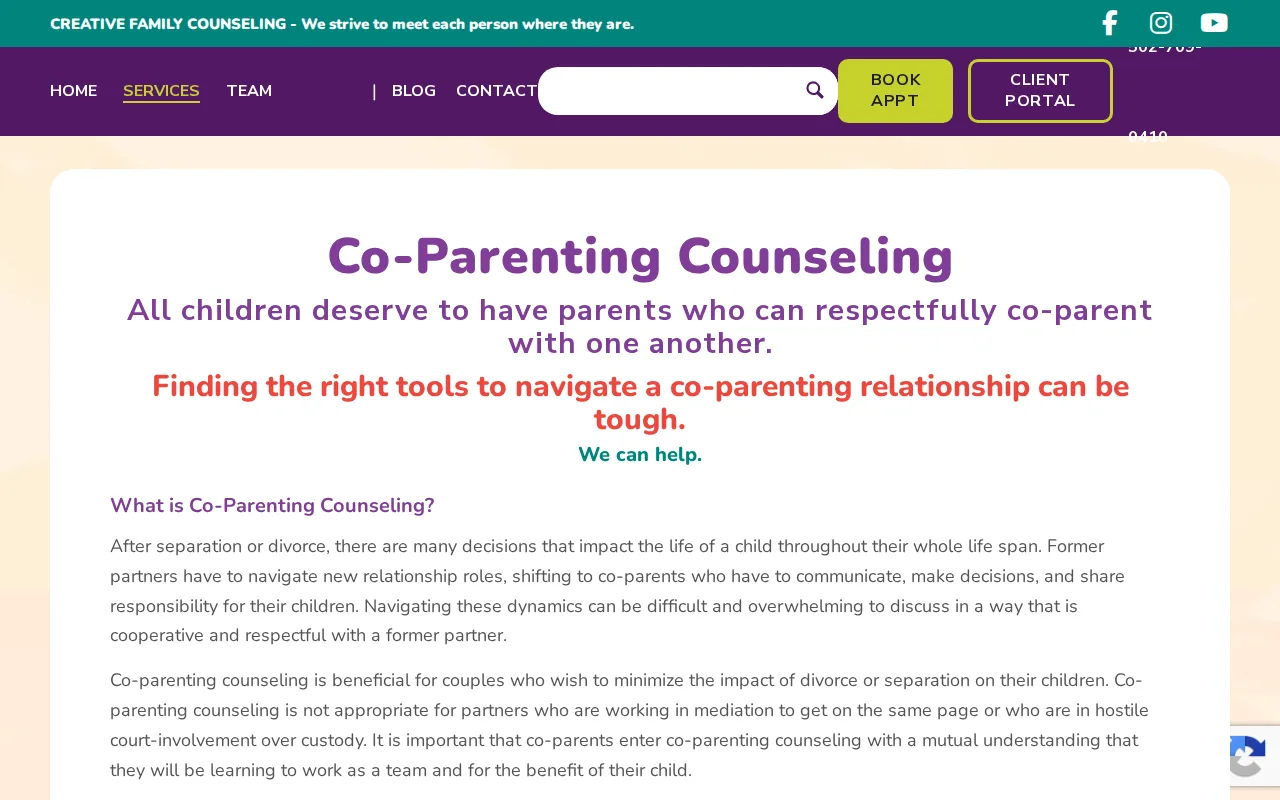
The counseling process often includes role‑plays of difficult conversations and the creation of a joint parenting plan.
Choosing the right fit means matching the therapist’s style with your family’s routine and the level of conflict you face. Some parents prefer a therapist who can help draft a concrete calendar; others value a more flexible, conversation‑focused approach.
How to choose
Do you need a single parent focus or a joint‑parent plan?
Is in‑person work essential, or will virtual sessions work?
Does the provider accept your insurance or offer a sliding scale?
Frequently Asked Questions
What is the difference between individual and family counseling?
Individual counseling centers on the parent’s own patterns, while family counseling looks at the interaction loops among all members. Both can improve communication, but the scope and participants differ.
Can I get insurance coverage for parenting counseling?
Many plans cover mental‑health services when the provider is in‑network. Check your coverage with your insurer and with the practice before you start.
How long does each type of counseling usually last?
Individual sessions often run 45‑60 minutes weekly for a few months. Group‑based programs may span 8‑12 weeks with weekly meetings. Co‑parenting work can be shorter if the main goal is to set up a clear plan.
When should I seek professional help?
If you notice persistent conflict, your child’s mood or behavior changes dramatically, or you feel stuck despite trying self‑help resources, consider reaching out. In a crisis, call 988 or go to the nearest emergency department.
Do I need to involve my child in counseling?
It depends on the approach. Parent‑child and attachment‑focused sessions include the child, while individual parent or co‑parenting work may focus solely on adults. The therapist will suggest what best fits your goals.
Ready to see which option aligns with your family’s situation? Take the free 2‑minute family peace assessment and get a clear next step. You can also explore our family video membership .
References
Johnson, S. M. (2019).Attachment theory in practice: Emotionally focused therapy (EFT) with individuals, couples, and families. Guilford Press.
Linehan, M. M. (2015).DBT skills training manual(2nd ed.). Guilford Press.
Minuchin, S. (1974).Families and family therapy. Harvard University Press.



Comments