
Understanding the Competence‑Incompetence Cycle in Couples
- FG&C Team
- Jun 24
- 5 min read

Ever feel like you're always the one fixing things while your partner drifts away? That back‑and‑forth pattern is the competence‑incompetence cycle in couples. Below we unpack what it looks like, why it happens, and how to change it.
1. What Is the Competence‑Incompetence Cycle?
The competence‑incompetence cycle describes a loop where one partner repeatedly takes charge (the "competent" role) and the other repeatedly steps back (the "incompetent" role). Over time the over‑functioning partner grows resentful, while the under‑functioning partner feels inadequate and withdraws.
Research calls this a form of "weaponized incompetence" , deliberately or unconsciously avoiding tasks to shift the burden (see ReachLink's overview). The pattern can start small, like one partner handling taxes while the other pretends to forget, but it quickly spreads to chores, finances, and emotional work.
When the loop tightens, the competent partner may start micromanaging, and the other may respond with silence or avoidance. The result is a growing gap in trust and satisfaction.
Breaking the cycle means each person learns to step back and step forward at the right time.Key Takeaway:The loop survives because the roles become habit; changing the habit requires both partners to shift behavior together.

2. Attachment Styles and Their Role in the Cycle
Attachment theory explains why partners fall into predictable roles. People with anxious attachment often become the pursuer , they push for connection and may over‑function to feel secure. Those with avoidant attachment tend to withdraw, taking the "incompetent" slot.
When an anxious partner constantly steps in, the avoidant partner learns that stepping back is safe, reinforcing the loop. The pattern mirrors what Minuchin (1974) described as "family subsystems" that lock into roles to keep homeostasis.
Understanding your own attachment style helps you see why you gravitate toward a particular role. For example, if you notice you jump in to fix everything when you feel anxious, you may be acting from an anxious attachment pattern.
Therapist Dr. Samuel Eshleman Latimer often asks couples to map their attachment triggers before they try new behaviors.Pro Tip:Write down three moments in the past week when you felt the urge to either take over or shut down. Spotting the pattern is the first step toward change.
For a deeper look at attachment, check out Wikipedia's entry on attachment theory . It breaks down the four main styles and their relational impact.
3. Common Triggers That Reinforce Incompetence Phases
Every couple has specific moments that spark the loop. Common triggers include:
Unfinished chores that feel like a personal failure.
Financial decisions that one partner feels unqualified to make.
Emotional disclosures that feel too vulnerable.
When a trigger hits, the competent partner may rush to solve the problem, while the other retreats or gives a short, defensive reply. That response signals that the problem is still open, prompting another rescue attempt.
Seeing the trigger in action helps you pause before the loop starts.
If you recognize a trigger, try the STOP skill from DBT: Stop, Take a step back, Observe, Proceed mindfully. It gives both partners space to notice the pattern without reacting.
Want a usable checklist? Breaking the Loop: A Guide to Common Relationship Cycles walks you through spotting triggers and testing new responses.
4. Evidence‑Based Interventions to Disrupt the Cycle
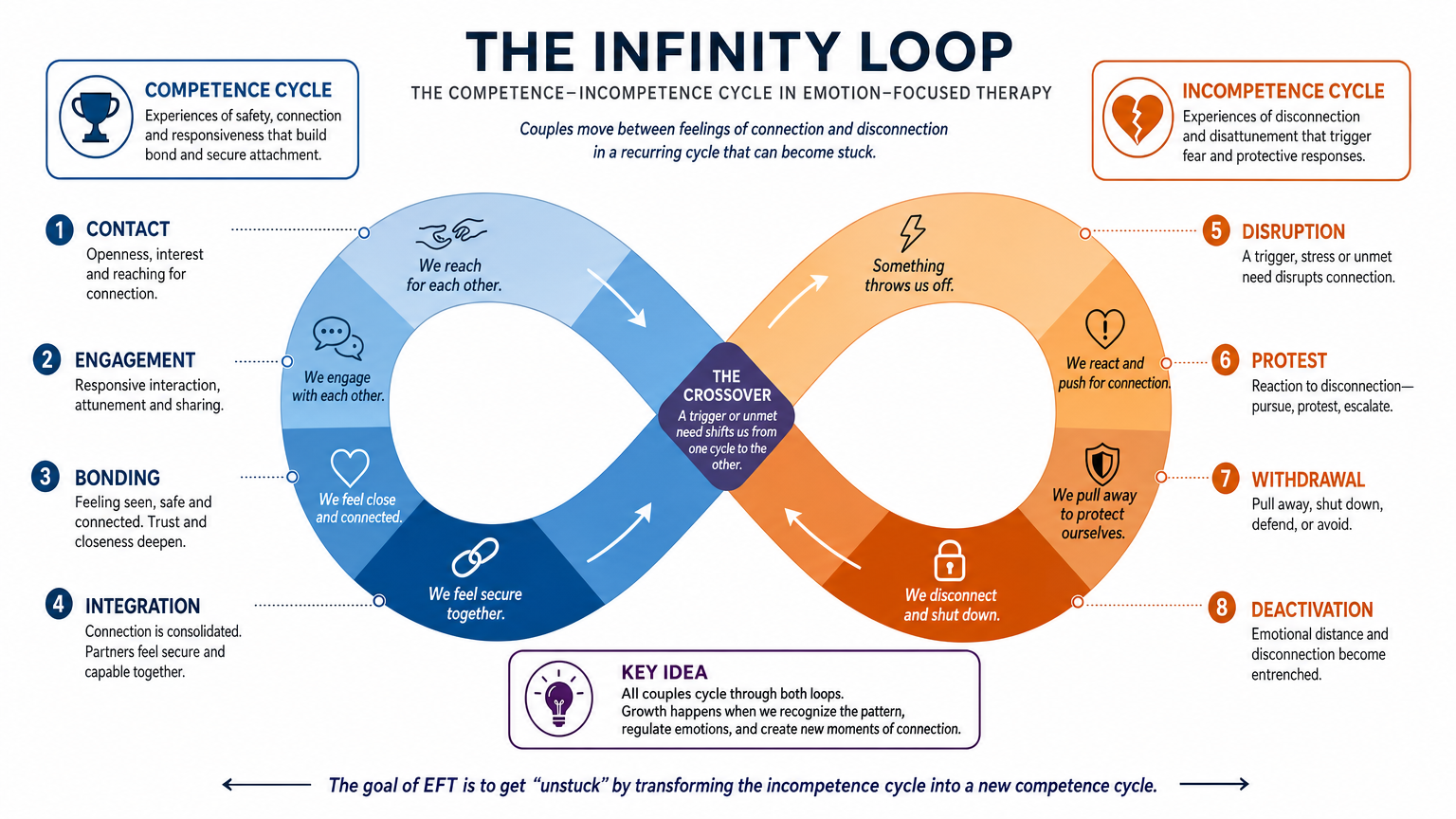
Emotion‑Focused Therapy (EFT) treats the competence‑incompetence loop as an "infinity loop" of interaction. EFT helps couples name the cycle, share underlying emotions, and create new, positive interaction patterns.
Research shows that couples who complete EFT report higher relationship satisfaction and lower conflict frequency (see Wikipedia's EFT entry for a summary of the evidence). The therapist guides each partner to express a primary need, often a need for safety or acceptance, while the other learns to respond with empathy rather than rescue.
Another effective tool is the STOP framework from Dialectical Behavior Therapy. By pausing before reacting, partners break the automatic escalation that fuels the loop.
Our team at Fostering Growth and Cooperation blends EFT and STOP in a structured program. The approach includes:
Identifying the exact moment the loop starts.
Practicing emotional validation instead of problem‑solving.
Assigning small, manageable tasks to the "incompetent" partner.
These steps create a new rhythm where both partners feel heard and capable.
5. Usable Steps for Couples and When to Seek Help
Start with a simple weekly check‑in. Each partner shares one area where they felt they fell into their old role and one area where they tried a new response.
Next, assign a tiny responsibility that the "incompetent" partner can own, like setting the timer for dinner or drafting a short email. Celebrate effort, not outcome.
If the pattern re‑emerges, use the STOP skill: pause, breathe, observe the feeling, then respond with a statement like, "I notice I want to fix this, but I'll wait for your thoughts."
When conflict feels stuck despite these attempts, consider professional support. Fostering Growth and Cooperation offers EFT‑based couples therapy, both in‑person in Cincinnati and online. Dr. Samuel Eshleman Latimer leads the team, bringing years of experience with attachment‑based work.
Take the free two‑minute family peace assessment to see if therapy might help: Family Peace Assessment . It takes less time than a coffee break and gives you a snapshot of your relational health.
Finally, remember that change is gradual. Expect setbacks, but keep the focus on building mutual competence.
For more on breaking negative cycles, read Confusion in Long‑Term Couples Relationships . It outlines how clarity emerges when both partners stop blaming and start mapping the pattern.
FAQ
What exactly is the competence‑incompetence cycle?
It is a repeating pattern where one partner constantly takes charge while the other consistently withdraws, leading to resentment and disengagement.
How does attachment style affect the cycle?
People with anxious attachment tend to over‑function to feel secure, while avoidant partners tend to withdraw, reinforcing each other's roles.
Can I break the cycle on my own?
Yes, small steps like weekly check‑ins, assigning tiny tasks, and using the STOP skill can create new habits, but professional guidance speeds the process.
Is Emotion‑Focused Therapy effective for this issue?
Research shows EFT helps couples identify and reshape interaction loops, resulting in higher satisfaction and less conflict.
When should we seek a therapist?
If you've tried the above steps for several weeks and still feel stuck, or if arguments feel destructive, a trained couples therapist can provide a safe space to re‑wire the pattern.
How long does therapy usually take?
Many couples see meaningful change after 8‑12 sessions of EFT, though the exact timeline varies by the depth of the pattern.
Conclusion
Our top recommendation is to try the competence‑incompetence break‑down with a brief weekly check‑in and a single, small responsibility for the partner who usually steps back. Then schedule a free assessment at Fostering Growth and Cooperation to explore EFT‑based therapy.
References
Johnson, S. (2019).Attachment‑Based Couple Therapy.New York, NY: Guilford Press.
Minuchin, S. (1974).Families and Family Therapy.Harvard University Press.
Jacobson, N. S., & Margolin, G. (1979).Marital therapy: Strategies and techniques.New York, NY: Wiley.
Baucom, D. H., Epstein, N., & LaTaillade, J. J. (2002).Cognitive‑behavioral couple therapy.New York, NY: Routledge.


Comments