
Free Family Peace Assessment Tool Download and Top Resources
Looking for a quick way to see how peaceful your family life is? Below are the free tools you can download or use online, plus tips on how to turn the results into a helpful talk.
The Free Family Peace Assessment from Fostering Growth and Cooperation
Fostering Growth and Cooperation offers a two‑minute interactive quiz that asks a few quick questions about everyday family life. The quiz lives on their website and gives you a short report that points out the biggest stress triggers. Because it’s online, you can take it on a phone, tablet, or computer without printing anything.
The report focuses on the environmental factors that add stress at home. After you finish, the report suggests small changes to your home environment that can ease that stress.
Ready to try it? Start the free family peace assessment and see what shows up.

Family Assessment Device (FAD): A Free 60‑Item PDF
The Family Assessment Device is a classic tool used by many clinicians (Epstein et al., 1983). It has 60 statements that each family member rates, giving a picture of how the whole system works. You can print it and fill it out by hand.
It focuses on family functioning and structure. Because it is free, it’s a good option when you want a deeper look than the two‑minute quiz.
You can find the PDF on the University of Maryland family assessment page .
Downloadable Family Systems Worksheets for Mapping Patterns
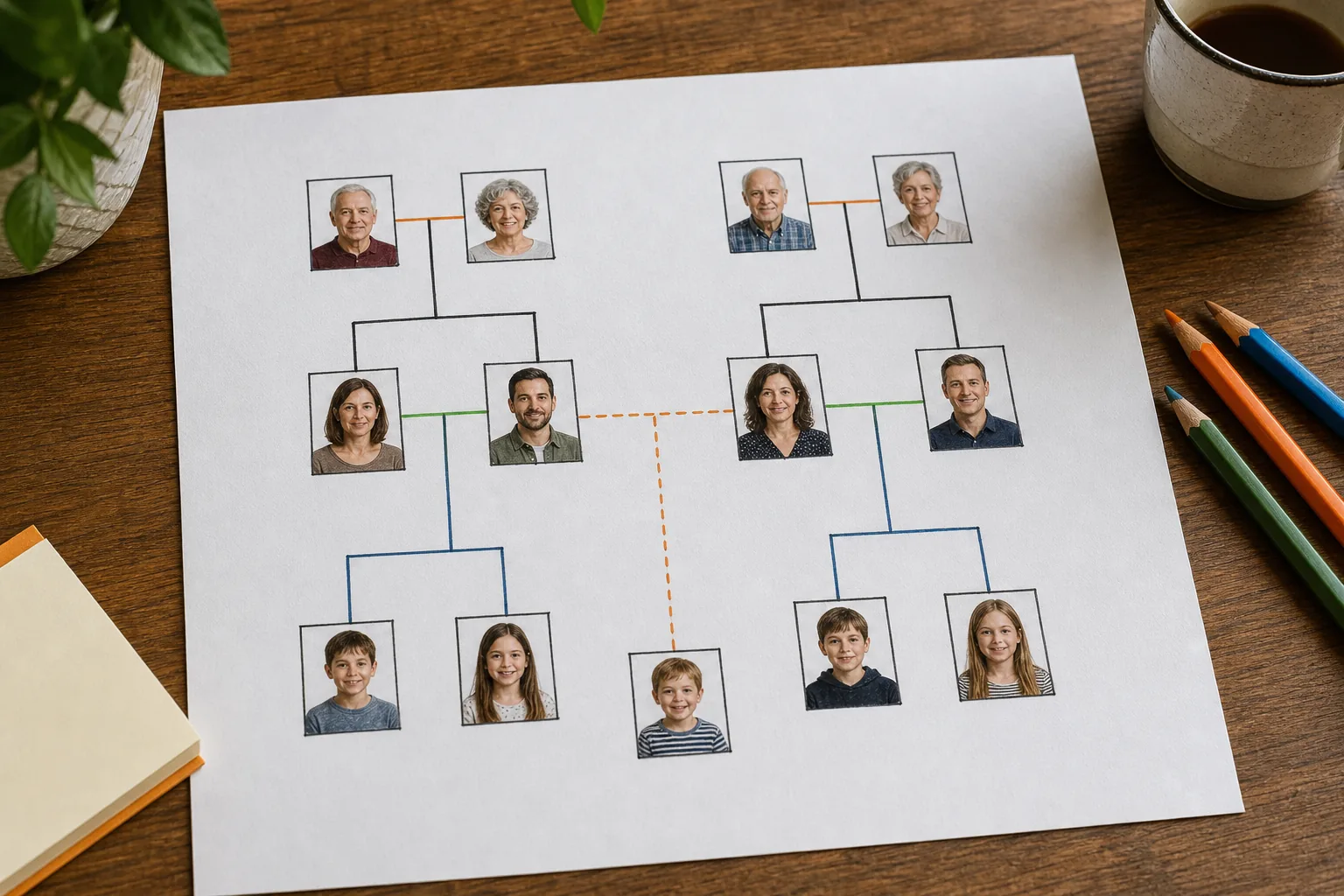
Mapping a family’s relationship patterns can make hidden cycles clear. Genogram worksheets let you draw three‑generation charts that show who is married, divorced, or has a close bond.
Free PDF genogram templates are widely available and follow the standard notation used in Bowen family systems work (McGoldrick et al., 2008). The templates include symbols for males, females, marriages, and emotional overlays like hostility or closeness.
When you fill a genogram, you often spot repeating anxiety or conflict that passes from one generation to the next. That insight can guide a therapist or a self‑help conversation.
For more information, visit Fostering Growth and Cooperation .
Other Family Functioning and Wellbeing Self‑Assessments
Beyond the two tools above, many short questionnaires are available. Some are free and some are licensed for clinical use only, so ask a therapist which one fits your family before you rely on a version you find online.
Use Assessment Results as Conversation Starters, Not Diagnoses
Whatever tool you pick, remember the scores are a talking point, not a medical diagnosis. A high conflict score simply tells you that the family may benefit from a focused conversation.
Start by sharing the overall pattern with everyone in the household. Ask each person what surprised them. Then pick one area that seems most urgent, maybe “communication clarity” or “shared decision making.”
If the pattern feels stuck, consider a brief session with a licensed therapist. Dr. Samuel Eshleman Latimer at Fostering Growth and Cooperation can help families explore the results in a safe setting. To see how that work is structured, read the Online Family Peace Program guide .
FAQ
What does a family peace assessment measure?
It measures everyday stressors, communication habits, and conflict triggers. The result is a short report that highlights the strongest areas for improvement.
How long does it take to complete the free online quiz?
The quiz is designed to take about two minutes, so you can try it during a coffee break.
Can I use the PDF worksheets without a therapist?
Absolutely. The worksheets are free to download and work well for families who want to map patterns on their own.
When should I see a professional?
If you notice persistent conflict, emotional distress, or any safety concerns, schedule a session with a licensed psychologist. In a crisis, call 988 or go to the nearest emergency department.
Conclusion
Start with the free two‑minute quiz to get a quick snapshot, then explore the deeper PDF tools if you need more detail. The next step is to take the assessment and use the report as a conversation starter.
Take the quiz now at Fostering Growth and Cooperation and begin building a calmer home.
References
Epstein, N. B., Baldwin, L. M., & Bishop, D. S. (1983). The McMaster Family Assessment Device.Journal of Marital and Family Therapy, 9(2), 171–180.
McGoldrick, M., Gerson, R., & Petry, S. (2008).Genograms: Assessment and intervention(3rd ed.). W. W. Norton.



Comments