
Online Family Therapy Programs: 4 MFT Options

Choosing a family therapy program online starts with one key distinction: some options train future therapists, while others provide therapy to families now. Here are four named options, plus the checks that can help you compare accreditation, cost, clinical training, and state licensure requirements.
1. Online Master’s in Marriage and Family Therapy by Touro University Worldwide
This is an online master’s program in marriage and family therapy. Its name makes it a degree option to investigate if you’re preparing for clinical work with couples and families.

Before applying, ask for the program’s current accreditation status, total credit requirement, course sequence, tuition, and clinical placement details. Confirm whether the program’s curriculum meets the education requirements for the license you want in the state where you plan to practice. A degree title alone can’t confirm that.
Ask how the school supports students in finding practicum sites and approved supervisors near them. Find out whether clinical hours must happen in person, whether remote supervision is allowed, and how the program handles a placement that falls through. Those answers can shape your schedule as much as online coursework does.
Also ask which courses cover family systems , assessment, ethics, and work with diverse families. These topics help you see how the curriculum approaches relationships and clinical judgment, rather than focusing only on the format of classes.
This option is worth a closer look if its current curriculum and fieldwork rules match your state’s requirements. Get the answers in writing before you compare it with another school.
2. Online Master of Marriage and Family Therapy by Abilene Christian University: online Master of Marriage and Family Therapy
Abilene Christian University’s online Master of Marriage and Family Therapy is a 60-credit program. The university describes a minimum completion time of 33 months, including at least 12 months of internship.
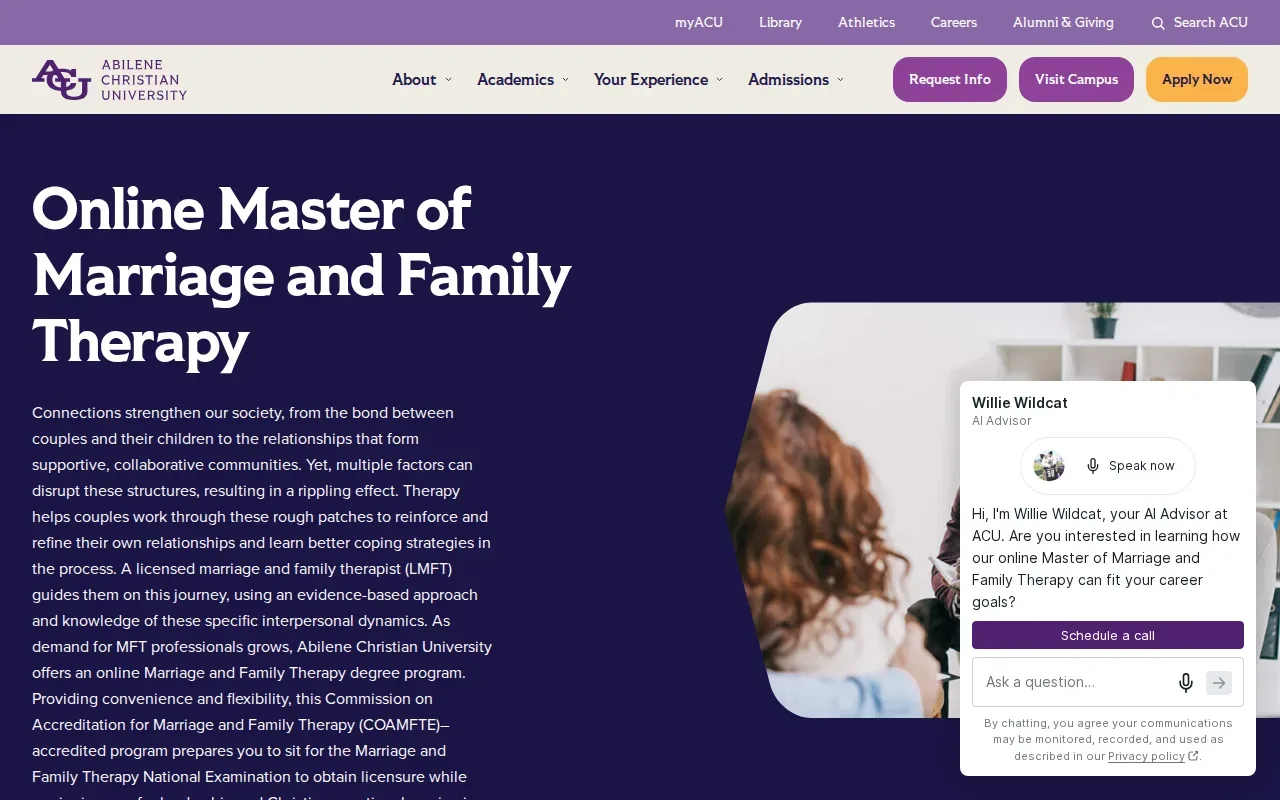
The stated curriculum includes family theory, systemic diagnosis and assessment, addictive disorders, cultural diversity in family therapy, and couples therapy. The program also includes training related to child and family therapy, mental illness, and substance use. A required internship is part of the training, with at least 100 hours of supervision noted in the program information.
Tuition and fees may vary. Ask the university to confirm the current amount and provide a full estimate that includes fees, internship-related expenses, and any transfer-credit decisions.
ACU lists four concentration areas: child and adolescent therapy, military families, trauma treatment, and medical family therapy. Program completion does not by itself establish eligibility for every state license.
For someone comparing online MFT training, ACU provides specific details on credits, time, coursework, and internship. Check its online MFT program information alongside your state board’s rules.
3. Online Family Therapy by Growing Self

Growing Self is an online family therapy service, not a degree program that trains future marriage and family therapists. The distinction matters: a family seeking support may compare therapy providers, while a prospective clinician needs an accredited academic program and supervised clinical training.
Growing Self provides virtual therapy via Skype and communication-skills workshops. It also describes the service as geared toward work with young children. Those details may help a family decide what questions to ask about session format, child involvement, and the therapist’s experience with the family’s concerns.
This option does not belong in a shortlist of MFT degrees. If you’re comparing it as a therapy service, ask whether the clinician is licensed to provide care where each family member is located, how sessions include children, and what the service costs. Online care is still subject to professional and state rules.
For prospective students, use this listing as a reminder to separate education from care. A program that offers family therapy does not automatically offer a degree, practicum, or pathway to licensure.
4. MA in Marriage and Family Therapy by National University

The listed option is an MA in Marriage and Family Therapy by National University.
Ask the university to identify the exact degree and catalog year you would enter. Then request the current credit total, course list, total tuition estimate, and a written description of required clinical placements. If the school describes a different MFT degree or pathway, make sure you’re comparing the same credential you intend to pursue.
Check whether the program holds COAMFTE accreditation and whether your state board accepts its coursework and supervised experience. Ask about the school’s process for reviewing licensure requirements in your intended state. A university’s general statement that a degree prepares students for practice may not address every state’s rules.
Use this option only after you have confirmed the exact program and its current requirements. Clear answers make a side-by-side comparison more useful than the degree name alone.
Compare online MFT programs: accreditation, curriculum, cost, and format
A program comparison should focus on facts that affect your path to licensure. Start with accreditation, then check curriculum and fieldwork. An online course format doesn’t remove the need to meet clinical training requirements.
Option | Program or service | What to verify before deciding |
Touro University Worldwide | Online master’s in marriage and family therapy | Accreditation, credits, tuition, clinical placement, state eligibility |
Abilene Christian University | Online Marriage and Family Therapy degree program; 60 credits | Accreditation, full cost, current state eligibility, placement logistics |
Growing Self | Online therapy service, not a degree | Provider licensure, session format, service cost |
National University | Named MA option | Exact program, accreditation, curriculum, tuition, clinical requirements |
Accreditation is a key point to check for marriage and family therapy education. It is not a substitute for a state licensing board’s rules. Ask each school to explain how its curriculum aligns with the state where you plan to practice, and confirm those details with that state’s board.
Course titles can help you compare what students study. Look for family theory and systems-based coursework, followed by assessment and ethics. Then check how the program teaches work with couples, children, and families whose needs or backgrounds differ.
Tuition is only one part of the cost. Include fees and ask whether there are added expenses for required clinical training, travel to placements, or supervision.
Format also needs a close look. Ask how often students attend live classes, how instructors give feedback, and what technology is needed. If several family members will need to join clinical sessions as part of training, ask how the school arranges those sessions and protects privacy.
Licensure, practicum, and career considerations for online MFT students
Marriage and family therapist licensure is governed by state requirements. Those rules may set education, supervised clinical experience, examinations, and application standards. Check the board in the state where you intend to practice before enrolling, and repeat the check if you move or change your planned work location.
Ask the program for its licensure disclosure for your state. Then compare the disclosure with the board’s own requirements. Confirm whether online coursework counts, what types of clinical placements qualify, and how supervision must be documented. Don’t rely on a general claim that a degree leads to licensure everywhere.
Practicum is a major part of the decision. Ask who helps locate a placement, whether students arrange their own sites, and what happens when local placements have no openings. Confirm the number and type of supervised hours required by both the program and the state board. A remote course can be flexible, while a clinical placement may still require in-person work.
Graduates may seek work in settings such as private practice, community mental health, hospitals, or nonprofit services. The roles available depend on license status, employer rules, and the graduate’s training. Salary expectations also vary by location, setting, experience, and whether a person is fully licensed. Check current occupational data for your region rather than using a single national figure as a promise of future pay.
If you’re trying to understand what family therapy delivered online looks like for clients, our overview of how online family therapy works explains the service format. Fostering Growth and Cooperation provides evidence-based clinical services for couples, families, and groups; therapy is separate from a graduate degree or professional training program.
For current mental health concerns, a degree comparison is not a substitute for care. Seek help from a qualified health professional. If someone may be in immediate danger, call 911; for a mental health crisis, call or text 988.
Specializations, financial aid, and support in online MFT programs
Concentrations can shape the focus of a program, but they don’t replace the core training needed for clinical work. ACU lists areas related to children and adolescents, military families, trauma, and medical settings. Ask whether a concentration changes the required course sequence or affects the time needed to complete the degree.
Also ask how cultural context appears in the curriculum. ACU’s listed coursework includes cultural diversity in family therapy. In any program, ask how students learn to consider a family’s values, community, and lived experience without treating one family pattern as the norm.
For financial aid, begin with the school’s financial aid office. Ask which federal aid may apply, whether scholarships are available to graduate students, and what deadlines apply. If you work for an employer with tuition support, request its policy in writing and confirm whether the program and course load qualify. Build a term-by-term budget that includes fees and clinical placement costs.
Student support can affect the day-to-day experience of online study. Ask how quickly students can reach an advisor, how clinical placement questions are handled, and whether academic support is available online. Request details about the learning platform, live class schedule, and technical help. These answers are more useful than a broad promise of flexibility.
Fostering Growth and Cooperation is a Cincinnati-based clinical psychology practice led by Dr. Samuel Eshleman Latimer, a licensed clinical psychologist. Its therapy and educational resources are intended for families seeking support, not for students seeking an MFT credential.
Pro Tip:Save each school’s licensure disclosure and cost estimate. Compare those documents with the board rules in your intended state before you pay an enrollment deposit.
If you’re a parent looking for support rather than a therapist degree, the practice’s overview of attachment-based family therapy online can help you understand how a therapy approach differs from professional training.
Key Takeaway:A degree, an online therapy service, and a clinical license are different things. Confirm each one separately.
Next step:If your concern is family stress rather than graduate study, Fostering Growth and Cooperation has a free family peace assessment to help you consider whether its resources may fit. Start the family peace assessment at your own pace.
Frequently asked questions
Can I become a marriage and family therapist with an online degree?
An online degree may be part of the path, but it doesn’t automatically qualify you for licensure. Requirements vary by state and may include specific graduate coursework, supervised clinical experience, and exams. Before enrolling, ask the program for its state licensure disclosure, then confirm the requirements directly with the licensing board where you plan to practice.
What does COAMFTE accreditation mean for an MFT program?
COAMFTE accreditation can be a useful point of comparison when reviewing MFT programs. Still, accreditation alone doesn’t confirm that every state will accept a program for licensure, so check your state board’s rules and the program’s disclosure.
How much does an online MFT degree cost?
Cost depends on the school, credit total, fees, and any expenses tied to clinical training. Ask ACU for current tuition, fees, and a total estimate, and compare it with financial aid or employer tuition support you may qualify for.
Is online family therapy the same as an online MFT degree?
No. Online family therapy is a service for families who want clinical support. An online MFT degree is an academic program for people preparing for professional work. Therapy services don’t provide a graduate credential, and a degree program is not itself therapy for a family. Check which kind of support you need before comparing options.
How do I check if an MFT program meets my state’s requirements?
Start with the licensing board for the state where you plan to work. Review its education, supervised experience, and examination rules. Ask each school for a state-specific licensure disclosure and compare it with the board’s current information. If anything is unclear, ask the board or program to explain the requirement in writing before you enroll.
Conclusion
If you’re pursuing an MFT license, begin with state eligibility and supervised training, then compare program cost and curriculum. If you’re seeking family support instead, consider services designed for clients rather than degree programs. For families weighing that next step, Fostering Growth and Cooperation’s free assessment is a low-pressure place to consider what kind of support may fit.
References
Abilene Christian University. (n.d.).Online Master of Marriage and Family Therapy.
Bowlby, J. (1988).A secure base: Parent-child attachment and healthy human development. Basic Books.
Johnson, S. M. (2019).Attachment theory in practice: Emotionally focused therapy (EFT) with individuals, couples, and families. Guilford Press.
Minuchin, S. (1974).Families and family therapy. Harvard University Press.



Comments