
How to Get Kids to Do Chores Without Nagging
Nagging feels like the only tool you've got. But it's the one that backfires most. The good news: kids do more around the house when you stop pushing and start building cooperation into the family system itself. Here are six steps, grounded in relationship science and a little ancient wisdom, that break the nag cycle for good.
We're Fostering Growth and Cooperation , a Cincinnati clinical psychology practice. We help families trade power struggles for real teamwork. Let's get into it.
Table of Contents
Step 1: See Nagging as a Cycle, Not a Character Flaw
Your goal here is simple: stop blaming your kid (or yourself) and start seeing the loop. Nagging isn't a sign your child is lazy. It's a pattern both of you got stuck in.
Here's how the cycle runs. You ask. They stall. You ask again, louder. They tune out. You snap. They comply just enough to make you stop. Then it resets tomorrow. Family systems theory calls this a repeating loop where each person's move pulls the next. Families aren't a pile of separate people. They're a system, and the system keeps doing what it's built to do.
So the fix isn't a better lecture. It's changing the loop. When you treat chores as a relationship problem instead of a willpower problem, your whole approach shifts. You stop trying to win. You start trying to redesign.
This same idea drives how couples and parents break stuck patterns. We dig into it in our piece on breaking negative relationship cycles through shared goals , and the logic carries straight over to chores. Name the pattern. Then change your part of it.
Attachment research backs this up. Children build self-worth through real participation, not through being managed. According to attachment theory , kids who feel securely connected are more willing to cooperate, because cooperation feels like belonging, not surrender.
Key Takeaway:The nag cycle is a system you both maintain. Change your move, and the loop has to change too.
Step 2: Build Cooperation by Modeling, Not Commanding
Your goal in this step: show the behavior instead of ordering it. Kids copy what they see far more than what they're told.
Think about how toddlers act. A two-year-old begs to help wash dishes, splashes water everywhere, and feels proud. Most of us shut that down because it's messy and slow. But that early urge to help is gold. Let kids practice basic skills early, without shame for doing it imperfectly. The mess now buys you a helper later.
Anthropologists have noticed something striking. In many Indigenous and hunter-gatherer communities, parents assume childrenwantto contribute, so they fold kids into real work from the start. NPR reported on Maya families where young children pitch in willingly because helping is just what the family does, not a battle to be won. We pull together more of these patterns in our notes on cooperative household tips from hunter-gatherer societies .
The most useful move? Ask, don't command. Try "Would you be willing to fold laundry with me?" If they say no, drop it. No guilt trip. The willingness matters more than the one load of laundry.
Then do it together. And don't correct how they do it. If your kid folds a towel into a lumpy ball, let it be a lumpy ball. Criticism teaches them that helping comes with a side of judgment, so they stop offering. Modeling means working beside them, not hovering over them.
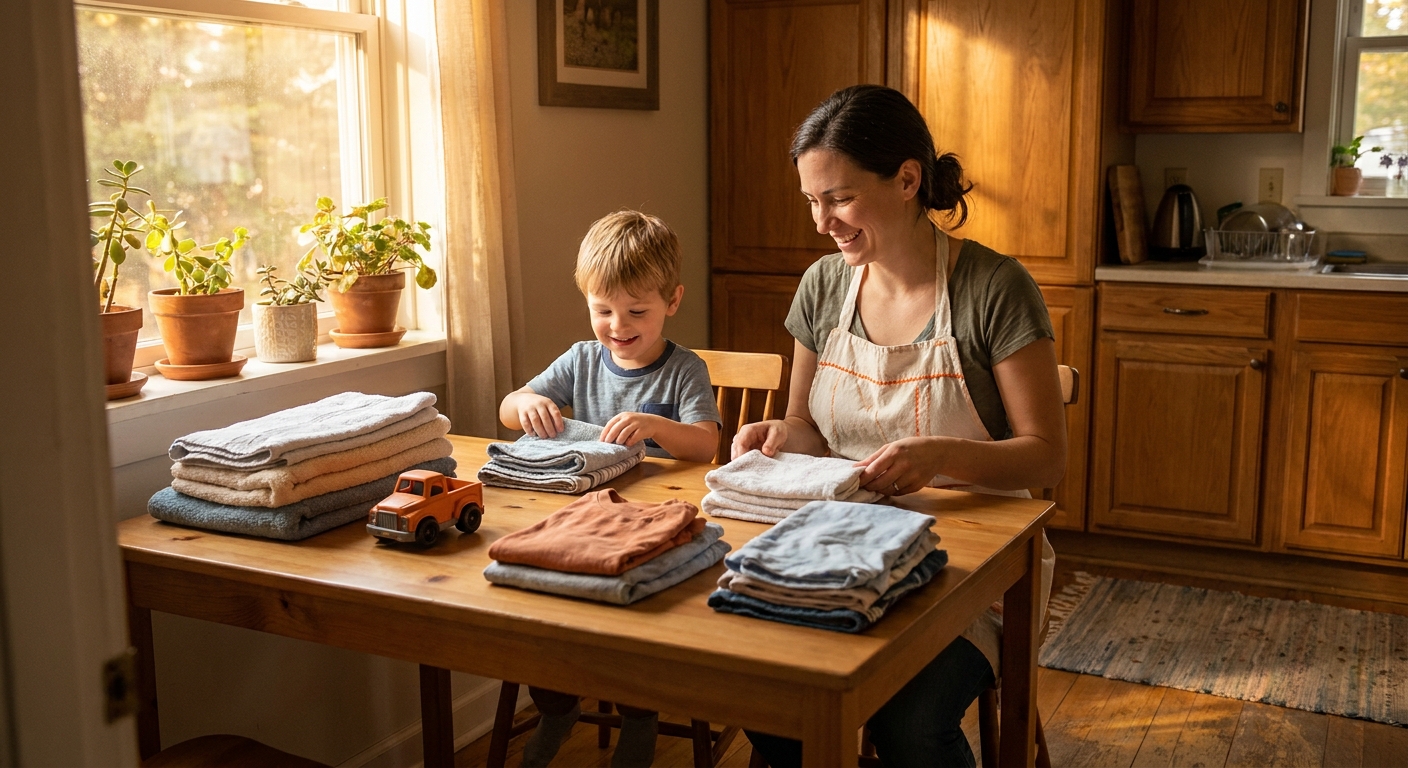
One more reframe. The research we reviewed found that "real contribution builds intrinsic motivation and pride" was the single most-cited principle across expert sources. Mock work, the kind invented just to keep a kid busy, does the opposite. It erodes pride because kids can tell it doesn't matter.
Step 3: Change the Environment So Chores Run Themselves
The goal here is to make the right action the easy action. Stop relying on willpower. Redesign the space so chores almost happen on their own.
Behavior is shaped by the environment around a person, not just by what's inside their head. Apply that to your kitchen. If the laundry hamper is on the far side of the house, clothes hit the floor. Move it. If snacks are out of reach until the dishwasher is empty, the dishwasher gets emptied.
Habit research points the same direction. A cue, then a routine, then a natural payoff. Pick a cue that already exists in your kid's day. Maybe they always grab a snack right after school. That snack becomes the trigger to unload the dishwasher. No reminder from you needed.
Pro Tip:Let your child pick the cue and the timing. "You both unload the dishwasher daily. When works for you, after school or after dinner?" Choice lowers resistance and hands them control.
When the environment carries the load, you stop being the alarm clock. That's the whole point. You're not managing your kid minute to minute. The setup does it.
We map out how to redesign household routines this way in our guide on helping your family become more peaceful with proven strategies . Small environmental tweaks beat big willpower battles every time.
Curious how your own home setup is doing? Our free two-minute family peace assessment gives you a quick read. Take the assessment or start a free family trial to see where you stand.
Step 4: Match Chores to Age and Attachment Needs
Your goal: give each kid work they can actually succeed at. Unrealistic tasks breed frustration and resistance. Right-sized tasks build pride.
One of the gaps we found in popular chore advice is that almost nobody talks about age. Most tips get presented as if they work for every kid at every stage. They don't. A four-year-old and a fourteen-year-old need different jobs and different kinds of support.
Attachment needs shift with age too. Younger kids want to be near you, so chores donewitha parent land best. Older kids crave independence, so they do better with ownership over a whole task. Here's a rough guide to match the work to the stage.
Age Stage | Good-Fit Chores | What They Need From You | Common Pitfall to Avoid |
Toddler (2-3) | Putting toys in a bin, wiping spills, carrying napkins | Side-by-side help, zero criticism | Shaming messy attempts |
Young child (4-7) | Setting the table, feeding pets, sorting laundry | Clear demonstration first, patience | Expecting adult speed or polish |
Older child (8-11) | Loading the dishwasher, taking out trash, vacuuming | A cue and a routine, then space | Re-doing their work in front of them |
Teen (12+) | Cooking a meal, doing own laundry, yard work | Full ownership, a real say in which jobs | Micromanaging or surprise demands |
Notice the pitfall column. Most chore frustration traces back to a mismatch. You hand a six-year-old a job built for a ten-year-old, then wonder why it falls apart. Drop the task one notch, and cooperation returns.
Established parenting guidance stresses age-appropriate responsibility for exactly this reason. The skill has to fit the kid, or the whole thing stalls before it starts.
Step 5: Replace Reminders With Calm, Predictable Follow-Through
The goal in this step: trade nagging for natural consequences delivered calmly. Reminders teach kids to wait for the next reminder. Follow-through teaches them their choices have results.
Here's the shift. Instead of repeating yourself five times, you state the boundary once and let the natural consequence do the teaching. If the dishwasher doesn't get unloaded, clean plates aren't ready at dinner. That's not punishment. That's reality. Family systems work suggests that when a parent stays calm and emotionally steady, the whole family system tends to steady with them. Your calm is the lever.

This is what we call empathic confrontation. You name the limit, you acknowledge how your kid feels about it, and you stay regulated. "I get that you'd rather play right now. The dishwasher still needs unloading before screen time." No lecture. No raised voice. We break the method down in our article on natural consequences and empathic confrontation in family communication.
There's a counter-intuitive piece worth mentioning. Some parenting coaches push what they call low tolerances, meaning you correct a missed step right away and calmly add a small extra task, rather than letting it slide for the tenth time. It runs against the "just be endlessly patient" advice. Used calmly, not angrily, immediate and predictable follow-through often reduces the back-and-forth more than soft repeated reminders do.
The key word is calm. Anger turns a consequence into a power struggle. Steadiness turns it into a lesson. If you're learning to stay regulated under pressure yourself, that's worth real practice, the same patience and steadiness explored in resources on living with patience as a daily discipline . The skill transfers anywhere repeated frustration shows up.
Step 6: Hold Family Meetings to Share the Load
Your goal: make chores a shared family project, not a top-down order. A short weekly meeting turns "my mom's rules" into "how our family runs."
Keep it brief. Ten or fifteen minutes. Sit down together and talk through what needs doing this week and who wants which job. When kids help decide, they own the outcome. Forced participation breeds resistance. Chosen participation builds buy-in.
The language you use matters more than you'd think. Frame tasks around the family, not around you. Say "This helps all of us have a calmer evening," not "I need you to do this." Pro-social motivation, the drive to help the group, is far stickier than rewards or praise. When your kid does pitch in, skip "good job." Try "I noticed that works really well for us when we do it together." That ties their effort to connection, not to your approval.
We lay out this group-centered language and how to build cooperative routines in our piece on how cooperative social circles reduce household opposition. The meeting is where that culture takes root.
The underlying goal is simple: chores are family maintenance, not heroic acts to be rewarded. The meeting makes that shared reality plain, week after week.
Frequently Asked Questions
Should I pay my kids to do chores?
Most evidence says no, at least not for basic household tasks. Rewards work briefly, then the behavior stops the moment the reward stops. Paying for routine chores frames them as heroic rather than expected. Save money lessons for an allowance that teaches saving and budgeting, kept separate from family maintenance work everyone is simply expected to share.
Why doesn't a chore chart with rewards work?
Chore charts with prizes usually fail because they turn helping into pay-for-play with no sense of family community. One parent's classic story: a 10-year-old did one chore, earned 50 cents, and quit the chart for good. External rewards put the burden back on you to keep dangling them. Build a cue-and-routine habit tied to family benefit instead, and the behavior sticks far longer.
How do I get my toddler to help without making a mess of everything?
Let the mess happen and skip the criticism. Toddlers naturally want to help, so hand them safe, simple jobs like wiping a spill or dropping toys in a bin. They'll be slow and sloppy at first. That's the practice. Shaming early attempts teaches kids that helping invites judgment, which kills the urge to pitch in later on.
What do I do when my kid flat-out refuses a chore?
Stay calm and lean on the natural consequence instead of arguing. State the boundary once: the task needs doing before the next fun thing. Acknowledge their feelings, then hold steady without raising your voice. If you asked open-endedly and they said no, sometimes the right move is to drop that one request and rebuild willingness, rather than forcing a power struggle today.
How often should we hold a family meeting about chores?
Once a week works well for most families, kept to about ten or fifteen minutes. Use it to sort out who does what and to let kids choose jobs where possible. Regular meetings keep chores framed as shared family work rather than your personal demands, which is the surest way to get kids to do chores without nagging over the long run.
Conclusion
If you change one thing this week, make it Step 3: redesign your environment so the right chore becomes the easy chore. That single shift takes more pressure off you than any reminder ever could. Want a quick read on where your family stands right now? Take our free two‑minute family peace assessment at Fostering Growth and Cooperation, and we'll help you build cooperation that lasts. You can also start a free family trial to explore more tools.
References
Bowen, M. (1978).Family therapy in clinical practice. Jason Aronson.
Bronfenbrenner, U. (1979).The ecology of human development: Experiments by nature and design. Harvard University Press.
Minuchin, S. (1974).Families and family therapy. Harvard University Press.
Sprenkle, D. H., Davis, S. D., & Lebow, J. L. (2009).Common factors in couple and family therapy: The overlooked foundation for effective practice. Guilford Press.



Comments